

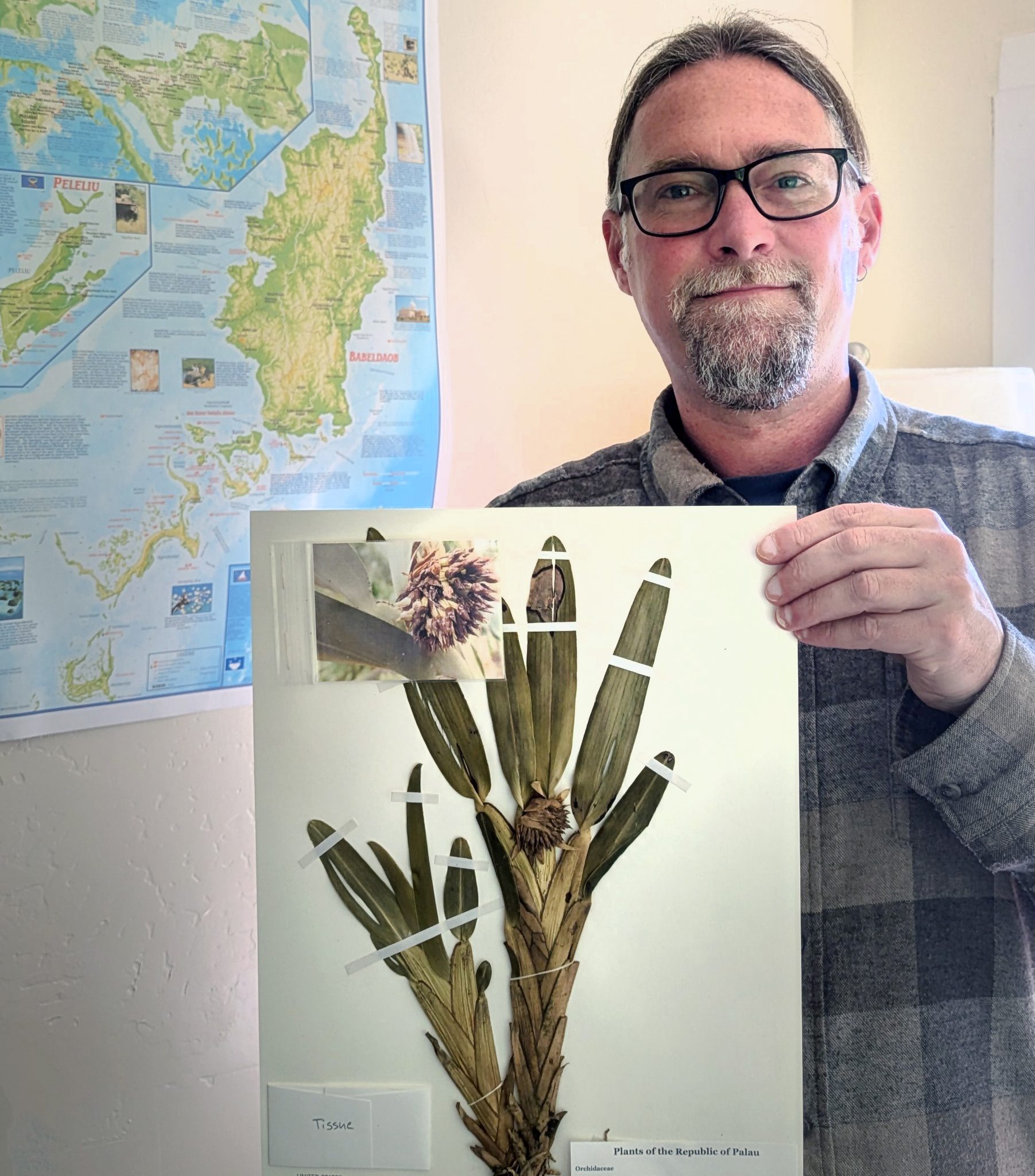

A University of Wisconsin-River Falls biology professor has helped identify a new orchid species found only in the Pacific island nation of Palau.
Benjamin Crain, an assistant professor of biology, is lead author of a paper published Aug. 18 in the journal Harvard Papers in Botany that describes the species, Agrostophyllum lkou. The name comes from the Palauan word for “hat,” a reference to a hood-like part of the flower, and is pronounced “oolko.”
Crain first came across the plant in 2018 on Babeldaob Island while working for the Smithsonian Institution’s North American Orchid Conservation Center as part of the Palau Orchid Conservation Initiative. He was there to map and classify known orchid species. He was not expecting to find a new one.
“I was out there working on a conservation project and then stumbled across something. I looked up and I was like, that looks like an orchid. And I’ve never seen anything like that before,” Crain said. “We got it down and I took one look at it and thought, ‘Oh, it’s an orchid, and I definitely have not seen this before.’”
“That was not a primary goal of the project, but as a conservation biologist, one of the first things you need to know is what’s out there,” he said.
The first plant Crain found was not in flower, so he could not describe it, even if it was a new species. In January 2023, he found plants in bloom.
“I didn’t even know if it was an orchid. It looked like an orchid, but with no flowers. So I recorded it, but that was it,” Crain said. “But then we found it at a different site and it was in bloom. And then later on, we found two more specimens.”
Crain has visited about 5,000 sites in Palau looking for orchids. According to the paper, the new species brings the number of published orchid species in Palau to at least 80. However, Crain notes that about 100 species have been found, but not all of them have been published.
A. lkou is listed as critically endangered under International Union for Conservation of Nature criteria. Fewer than 50 mature plants have been documented, and the researchers estimate that fewer than 250 exist.
“I’m certain that there’s more out there,” Crain said. “Now, that being said, part of it being established as critically endangered has to do with its overall range size. On an island that small, even if it was covering every inch of the island, it would still not cover a very wide area. So it’s still going to be endemic, which puts it as a higher risk of being extirpated or going extinct. I think we’ll probably find more, but I don’t think it will change the numbers overall.”
Many orchid species are under threat.
“Over 50% of all orchid species that have been assessed are listed as endangered, critically endangered, or some threat level to them, so while they’re the most diverse thing on Earth, they’re also highly fragile and highly threatened,” Crain said.
Still, orchids grow almost everywhere.
“Orchids are the most diverse plant family on Earth. There are more orchid species than any other type of plant,” Crain said. “People often think of orchids as these exotic tropical things, but orchids exist everywhere on the planet, with the exception of Antarctica. So, orchids are rare and exotic in many cases, but also can be found in your backyard. There’s multiple species at sites, just here in River Falls.”
Crain did not set out to study orchids. He studied conservation biology and planned to work with birds.
“I had a big interest in birds. But after undergrad I ended up at an internship at a botanical garden in Madison. They have rare plants,” he said. “During that time, a small species of orchid called Bulbophyllum fascinator bloomed. I just thought it was the goofiest thing, and I was fascinated by it.”
That sparked a passion. After the internship, Crain said, people saw him as “a plant person,” so he chose orchids for his master’s degree.
What he values most about orchids is that they keep him outdoors.
“I love orchids, and I love them because it’s taken me around the world. I love being outdoors, I love being dirty, I love being in the jungle, I love being in the field,” Crain said. “If you’re fascinated with orchids, there’s a good chance that they’ll get you outside no matter where you go.”
