

Joey Bragg joined Week of Welcome on Saturday, Jan. 31, performing a two-hour stand-up comedy set. During the performance, he reflected on his time working with Disney, his upbringing, his current life, and the political climate in the United States. He held a meet and greet for students interested in a photo afterwards. The event drew over three-hundred attendees, a turnout comparable to student participation in Midnight Mayhem the night before.
Bragg is a stand-up comedian and actor who first gained national recognition for his role as Joey Rooney on the Disney Channel series Liv and Maddie. Since his transition from television, Bragg has built a career in stand-up comedy, frequently performing at college campuses and entertainment venues nationwide. His performances typically feature observational humor, personal anecdotes and audience engagement, often incorporating references to pop culture and current events. In addition to live performances, Bragg maintains a social media presence, where he shares comedy content and promotes upcoming shows.
Sylvia Kass, Student Events and Activities Manager for the Office of Student Involvement, described that Bragg’s team reached out through email as he has been performing at schools in both Minnesota and Wisconsin. Kass brought the idea to the student employees who then decided it would be incredible to have such a recognisable name on campus.
“Typically, the student team and I choose entertainers through various talent agencies,” Kass said.
Student reactions to his performance at the university varied widely. Some audience members left only minutes after the set began.
Early in the show, Bragg made a comment referencing the U.S. Immigration and Customs Enforcement and continued to reference current political events throughout his set. Earlier that day, he attended a protest related to ICE in Minneapolis, which he posted about on his social media accounts.
Bragg, who is from Los Angeles, comes from a region that historically leans more politically liberal. Some students expressed frustration that political topics were included so prominently during a university entertainment event, while others viewed the commentary as part of Bragg’s comedic style and personal expression.
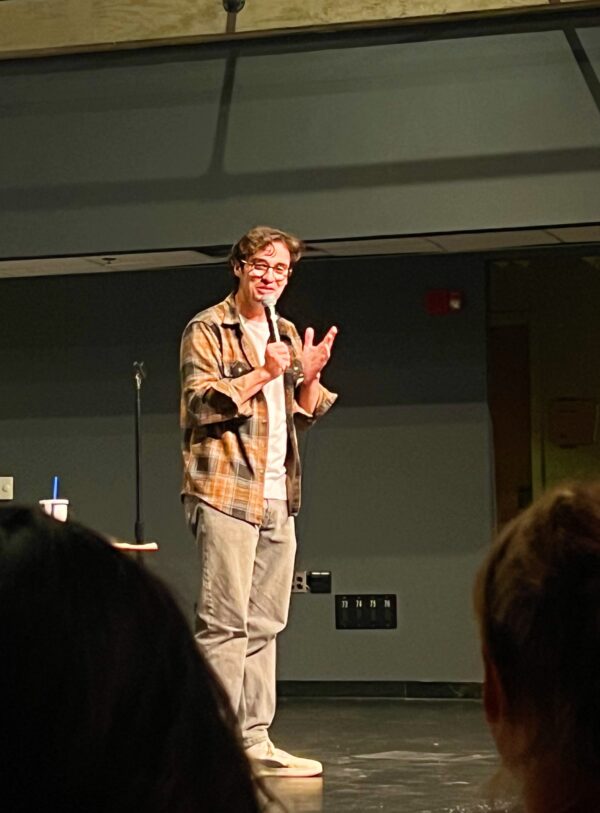
When asked about how to balance free expression with expectations from the student body, Kass stated, “We ask all comedians to tailor their set for a college-aged audience. Additionally, we begin the show by stating that performers are protected by the First Amendment and that their views do not represent the Office of Student Involvement or UW-River Falls.”
After conducting an anonymous survey of attendees, the average enjoyment rating for the event was 8.4 out of 10. The survey also included open-ended response sections where students could share more detailed feedback.
Students who responded to the question about what they liked frequently noted they appreciated his willingness to address current American political topics during his performance. One student wrote, “He was funny and incorporated real issues.”
However, responses to the question about what students disliked revealed a range of opposing views. Many respondents said they were uncomfortable with the amount of political content included in the set. Some students expressed that they felt the performance was too politically focused for an event at a public university. One student commented, “a lot of political comments that weren’t about comedy.”
While the survey did not directly ask students to evaluate the political content of the performance, many respondents chose to reference it in their feedback, suggesting the topic was a significant part of how attendees experienced the show.
Alignment with the political views expressed by Bragg was inferred through written comments students provided in the survey. Results suggested that students who appeared to share Bragg’s political viewpoints reported higher enjoyment levels than students who enjoyed the performance but did not indicate agreement with those views. The lowest enjoyment ratings were reported by students who indicated they did not enjoy the performance and had no comment on the political content.
Additional survey responses showed recurring themes among attendees. Many students highlighted Bragg’s Disney-related stories, audience engagement and relatable storytelling as standout parts of the performance. Others appreciated his willingness to discuss current events and political topics. However, several respondents said political commentary and extended joke segments occasionally distracted from the overall comedy. Even some students who agreed with Bragg’s viewpoints noted that they felt the political discussion sometimes overshadowed the humor.
One respondent said, “Although I agreed with the politics, he did overdo it.”
Another said, “I was very indifferent to the show and just found it mid overall.”
A few respondents also commented that the meet and greet could have been drawn out better. Rather than being instructed to, “form a line in the middle of the rows of chairs,” and that it instead should have been by individual rows of seats. Many commented that their friends had been pushed either going for the line or out of their spot entirely.
While the survey reflects the opinions of students who chose to respond, it may not represent the views of all attendees. However, responses still show a clear range of reactions to the event.
Students also expressed their opinions on the anonymous social media platform, YikYak. There were only a few, but the few were describing the experience with mixed thoughts. “I liked Joey Bragg, don’t get me wrong. But I was very uncomfortable during it”.
It is not to be overlooked that plenty of students had a good time at the show. Though politics were a clear topic of discussion among the students, the average was relatively high. There were many social media posts of the meet and greet and positive comments left on the survey too.
“I found some of his jokes and improvisations genuinely funny, and he had a high-spirited and upbeat personality.”
“I liked the story telling of the jokes and that they were suitable for the audience, being college students.”
Kass reminds that there is an engagement survey toward the end of the spring semester. Feedback from students helps inform future events. Students are also encouraged to reach out with thoughts or ideas.
“If you take the survey, you’ll even be entered to win a giveaway!”
Week of Welcome events are designed to build community and [re]introduce students to campus life. Students can make new friends and get involved in ways they might not have thought about. Upcoming events are posted on Instagram @uwrfgetinvolved
Kass says, “Students who are engaged on campus are more likely to stay in school, graduate on time, and have a higher GPA. Week of Welcome is just the beginning!”