

If there is any lesson a student should take from their time at a university, it is that communication is essential for success. Students must communicate with professors to understand course material and with advisers to plan their path to graduation or adjust those plans when circumstances change. Communication is just as important when interacting with the broader university system. Although the University of Wisconsin System can feel distant, decisions made at the system level directly affect individual campuses. Those decisions should be communicated clearly. That did not happen with the recent termination of UW System President Jay Rothman.
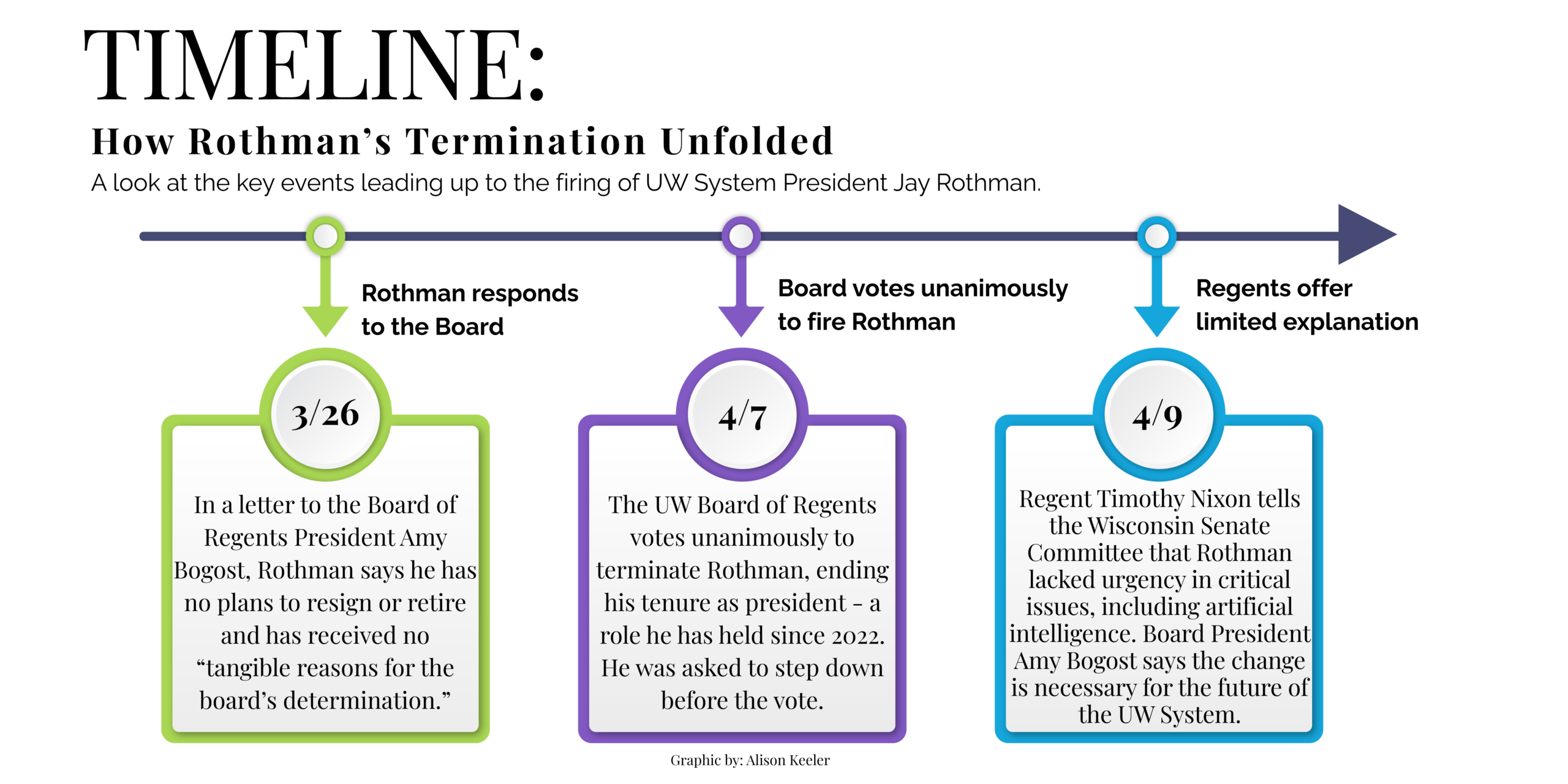
On April 7, the UW Board of Regents voted unanimously to fire Rothman, ending his tenure as president, a role he had held since 2022. Before the vote, Rothman was asked to step down. In a March 26 letter to Board of Regents President Amy Bogost, he said he had no plans to resign or retire and argued that he had been given no “tangible reasons for the board’s determination.” According to Wisconsin employment law attorney Tamara Packard, the board acted within its authority. Rothman’s contract allowed for termination without cause and did not grant him the right to appeal.
The regents have offered limited explanation for their decision. Two clear statements come from the Associated Press: Bogost said the leadership change was necessary for the future of the UW System, and Regent Timothy Nixon told the Wisconsin Senate Committee on Universities and Technical Colleges on April 9 that Rothman lacked urgency on critical issues, including artificial intelligence. Some Republican lawmakers have suggested that political motives may have played a role, pointing to Rothman’s 2023 agreement with GOP leaders that froze hiring for diversity, equity and inclusion positions. No members of the Board of
Regents have confirmed that claim.
The larger issue highlighted by this situation is the lack of communication with the universities affected by the decision. Most students do not closely follow UW System governance, but it is notable that even campus leadership was not informed. Dr. Karl Peterson, dean of the College of Arts and Sciences, confirmed that UWRF administrators were unaware of Rothman’s termination. He explained that while the UW System’s influence on campuses is often indirect, the system and the Board of Regents collaborate on initiatives and mandates that campuses may choose to adopt. The recent general education transferability mandate is one example.
A faculty member in the College of Education, Business and Allied Health, who asked to remain anonymous, noted an increase in coursework related to artificial intelligence and large language models, reflecting employer demand for graduates with AI experience. If a future UW System president prioritizes different initiatives, system, level decisions could influence how much AI‚ related instruction campuses choose to offer. This scenario is hypothetical, but it illustrates how system priorities can shape campus programs, and how those priorities are influenced by the system president.
This influence is not inherently negative. The UW System president plays an important role in guiding initiatives that support the system’s goals. But universities are the ones most affected by these decisions, and the motivations behind leadership changes should be communicated clearly and directly. Even the smallest voice deserves a place in the broader conversation about what is best for the UW System.