
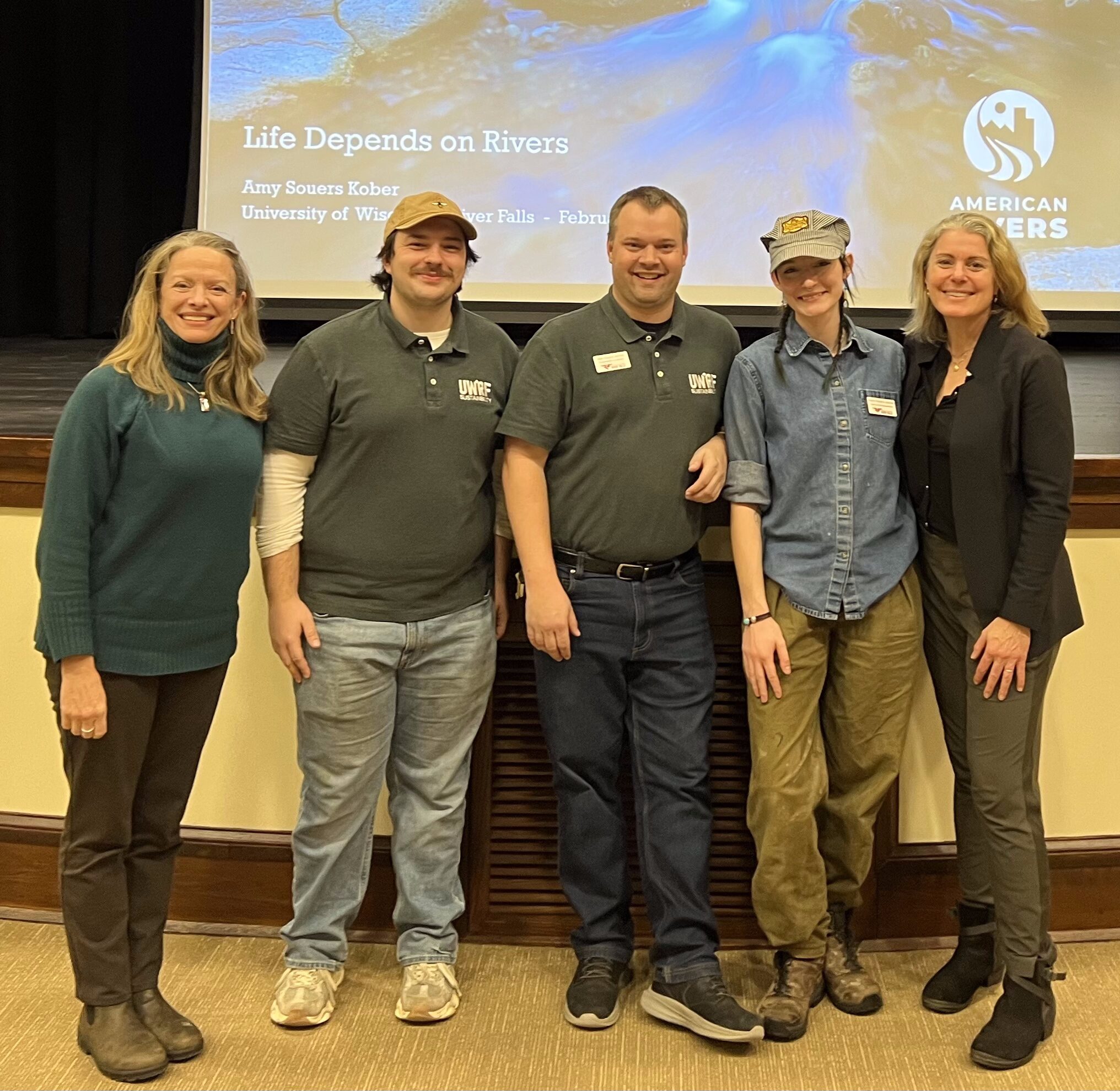
The February event for the Sustainability Speakers Series was held in North Hall, as remodeling still takes place at the River Falls Public Library. The presentation started at 6:30 p.m. and was open to the public. Amy Souers Kober’s presentation titled, Life Depends on Rivers: How Healthy Rivers Support Strong Communities, discussed the vital role that rivers play in supporting ecosystems, human health and climate resilience.
Mark Klapatch, UWRF Sustainability Coordinator, attended the event representing both the University of Wisconsin-River Falls Sustainability Office and Hope for Earth. Another notable attendee of the event was Grace Coggio. A professor at UWRF and the Communication Studies Program Director. She is also a UWRF Sustainability Fellow. Klapatch notes that Coggio was the one to set up Kober’s appearance.
From Portland, Oregon, Amy Souers Kober is a communications strategist and conservation advocate. She serves as the Vice President of communications for American Rivers. Kober oversees communications, marketing strategies, media relations, digital presence and brand goals.
Founded in 1973, American Rivers is a national effort in protecting and restoring our rivers. Members and advocates work to heal rivers, mobilize a movement, and transform state and federal policy.
With her time at American Rivers, Kober has directed communications for many high-profile river restorations, protections and clean water initiatives. She has also led communication efforts for one of American Rivers’ most recognizable campaigns, America’s Most Endangered Rivers®, which highlights waterways across the country that face significant environmental threats.
During the presentation, Kober shared the organization’s vision: “…a nation where every river is clean and healthy for people and wildlife.”
Kober emphasized the many ways rivers impact daily life, including food systems, wildlife habitats, and human communities. “Without our rivers,” she said, “the whole web of life collapses.”
She also addressed the climate pressures affecting rivers, including rising temperatures, shrinking snowpack, shorter wet seasons, more volatile precipitation, rising sea levels, and increasingly severe wildfires. “A climate crisis is a water crisis,” Kober stated. “Fresh water species are going extinct at a much faster rate than our land species.”
Engaging the audience, Kober asked attendees to think about a body of water they personally value. She then cited Blue Mind by Dr. Wallace J. Nichols, noting that “our brains are hardwired to react positively to water and that being near it can calm and connect us, increase innovation and insight, and even heal what’s broken.”
The rivers of the nation are worth protecting. They support daily life of both humans and animals. Humans can create a connection to a river, unlike animals, but they still need it to survive.
Kober also highlighted the American Society of Civil Engineers 2025 report card. They grade the infrastructure of the nation and noting trends improving or declining every four years. Kober highlights that wastewater, dams, and levees each have a rating of D+.
ASCE has the full report card on their website at asce.org. Levees and dams have both been marked as improving. Wastewater stays unchanged compared to 2021. Many other forms of infrastructure are graded. Darren Olson, P.E., BC.WRE, M.ASCE, the chair of ASCE’s Committee, has said that the report card is an important tool when talking to officials and the general public.
“So what are we going to do?” She asked rhetorically. “We heal rivers. We will mobilize a movement, transform policy. We work with river restoration across the country. We need everyone who needs water. We are more powerful together. Can we get political enough to get policies that will protect our rivers?”
Kober allowed audience members to ask questions once she finished her initial talk.
As she had brought up the importance of dams, an attendee asked what’s the reason to remove dams, some arguments heard for keeping dams and when do you decide it needs to stay?
Kober replied, “Historically, there’s lots of mining upstream so the sediment is contaminated. It is very rare for it to not be. It would be very expensive to truck out sediment, so instead we remove them. We’ve removed over two thousand across the country. We have worked with communities for collaborative solutions looking at these challenges. Once, we even decided one dam needed to go, but another dam needed to be raised higher. We try this: everyone gets something. We like to see when everyone wins.”
Another member wondered what it’s like to deal with opposition. How does this organization push for themselves when there can be harder pushback?
“Most effective way of opposition? Listening. Everybody comes at these issues with their own reasons and history. It’s important to honor that. Making sure all voices in the community are being heard but also being clear why we think this is a good idea for the river and the community.”
For more information regarding the nation’s rivers, visit americanrivers.org. On their website, there are also links to the podcast and films from those who work for the livelihood of the rivers.
Upcoming sustainability events will be held in North Hall Auditorium, room 222. On Thursday, Mar. 5 at 6:30 p.m., Marybeth Lorbiecki will present Aldo Leopold: A View for All Seasons and Centuries, exploring why Leopold’s life and writings continue to resonate today. On Saturday, Mar. 21 at 10:30 a.m., UWRF’s Sami Nichols, Ph.D., will speak on urban bird ecology as part of the St. Croix Valley Bird Club presentation.